
Warsaw, 1620-1680
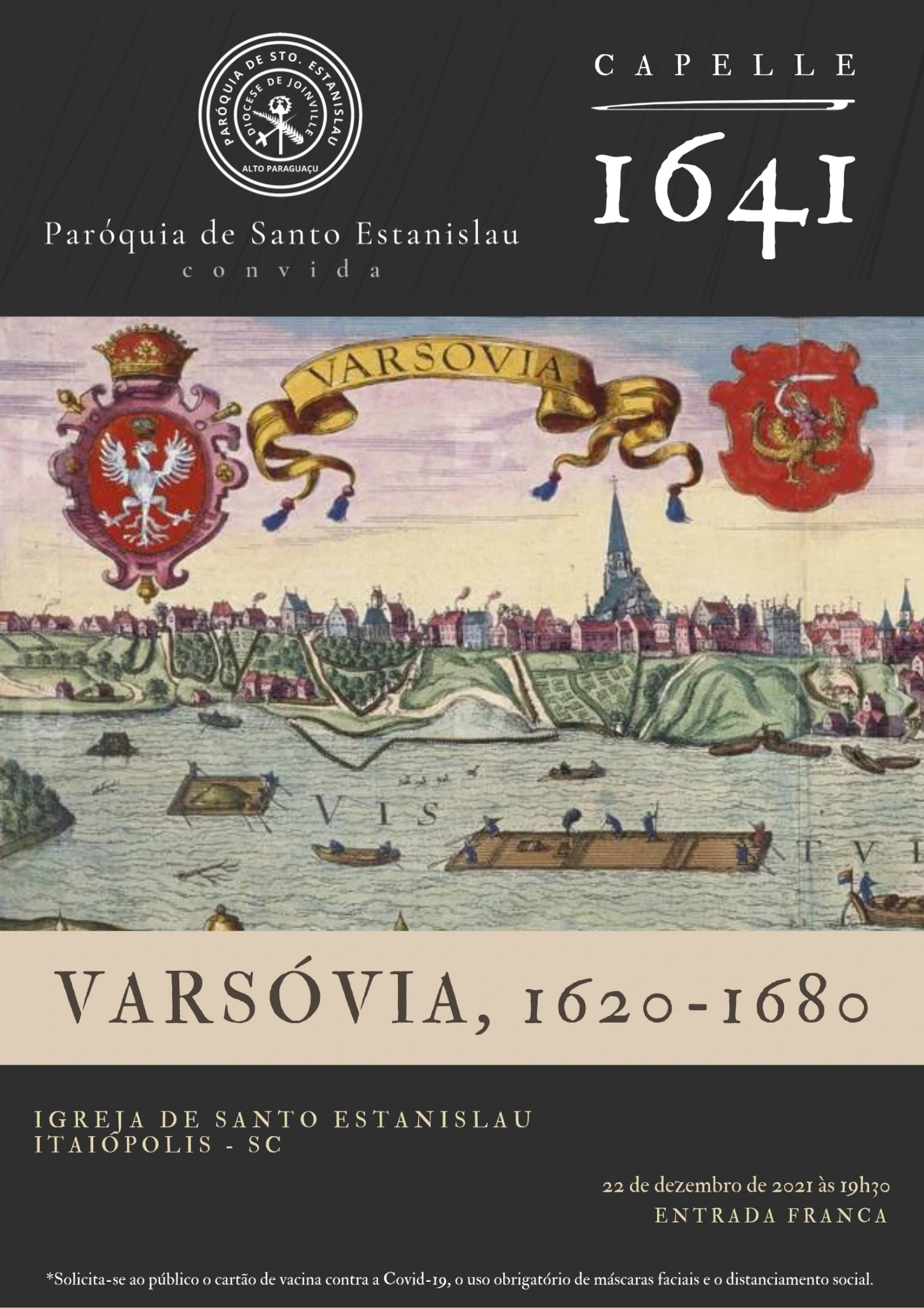
The Capelle 1641 dedicates Warsaw, 1620-1680 especially to the Polish community of Itaiópolis, Santa Catarina. The programme draws entirely on the chamber music repertoire of seventeenth-century Poland and the influences upon it.
Seventeenth-century Polish music has a mysterious beauty. Yet little of this repertoire has survived the past 400 years, for reasons that include natural disasters, wars and political upheaval. Access to these works remains limited today, and performances are uncommon even in Europe. With the arrival of the internet, some collections have been digitised and made publicly available for research and performance. This opportunity led the Capelle 1641 to seek out sounds from Poland’s musical world between 1620 and 1680. Some of the works performed here were taken from two manuscripts: the Partiturbuch Ludwig (1662) [“Ludwig’s Book of Scores”] and the Codex Rost (c. 1688) [“the Rost manuscript”], enigmatic sources whose contents have yet to be performed or recorded in full.
We are in Warsaw, Poland, in 1645. Charles Ferdinand Vasa, prince-bishop and brother of King Władysław IV, appoints a new musical director: Marcin Mielczewski, a composer about whose life little is known. Born around 1600, he is now regarded as one of the leading figures in seventeenth-century Polish music. We present two of his Canzone and an Aria. Franciszek Lilius (c. 1590-1657) and Carlo Farina (1600-1639) also reach us through the sources mentioned above. As with Mielczewski, little is known about Lilius, and only a small part of his work survives. From the Partiturbuch Ludwig, we have drawn his four-voice Aria, which appears to be receiving its first performance in Brazil. Carlo Farina was an Italian composer who, like many others, wrote pieces influenced by Polish music, allowing folk melodies to emerge in various ways. We perform a Pavana, a courtly dance. In the same context, we encounter the Austrian Johann Heinrich Schmelzer (c. 1623-1680). A virtuoso violinist in his day, he offers us his Polnische Sackpfeiffen (Polish Bagpipes), in which the strings evoke the folk bagpipes played in taverns and outdoors. No less important are Adam Jarzębski (c. 1590-1648) and Stanislaw Szarzynski (c. 1650-c. 1700). A member of Władysław IV’s court, Jarzębski wrote chiefly instrumental works based on vocal pieces, including his version of Corona Aurea (Golden Crown), inspired by a work by the Italian master Giovanni Palestrina (c. 1525-1594). Szarzynski, a monk of uncertain origins and affiliation, lived in the late seventeenth century and composed mainly sacred music. Only one instrumental work of his survives: a sonata for two violins and basso continuo, presented here.
Programme
Carlo FARINA (1600-1639) — Pavana
Adam JARZĘBSKI (c. 1590-1648) — Corona Aurea
Marcin MIELCZEWSKI (c. 1600-1651) — Canzona I; Canzona II; Aria
Stanislaw SZARZYNSKI (c. 1650-c. 1700) — Sonata
Johann Heinrich SCHMELZER (c. 1623-1680) — Polnische Sackpfeiffen
Franciszek LILIUS (c. 1590-1657) — Aria
Performers
- VICTOR TAMARINDO - Violin
- ALEXANDRE NANNI - Violin
- VINI CHIARONI - Violin and viola da braccio
- JOÃO GUILHERME FIGUEIREDO - Viola da gamba
- ROGER BURMESTER - Archlute