
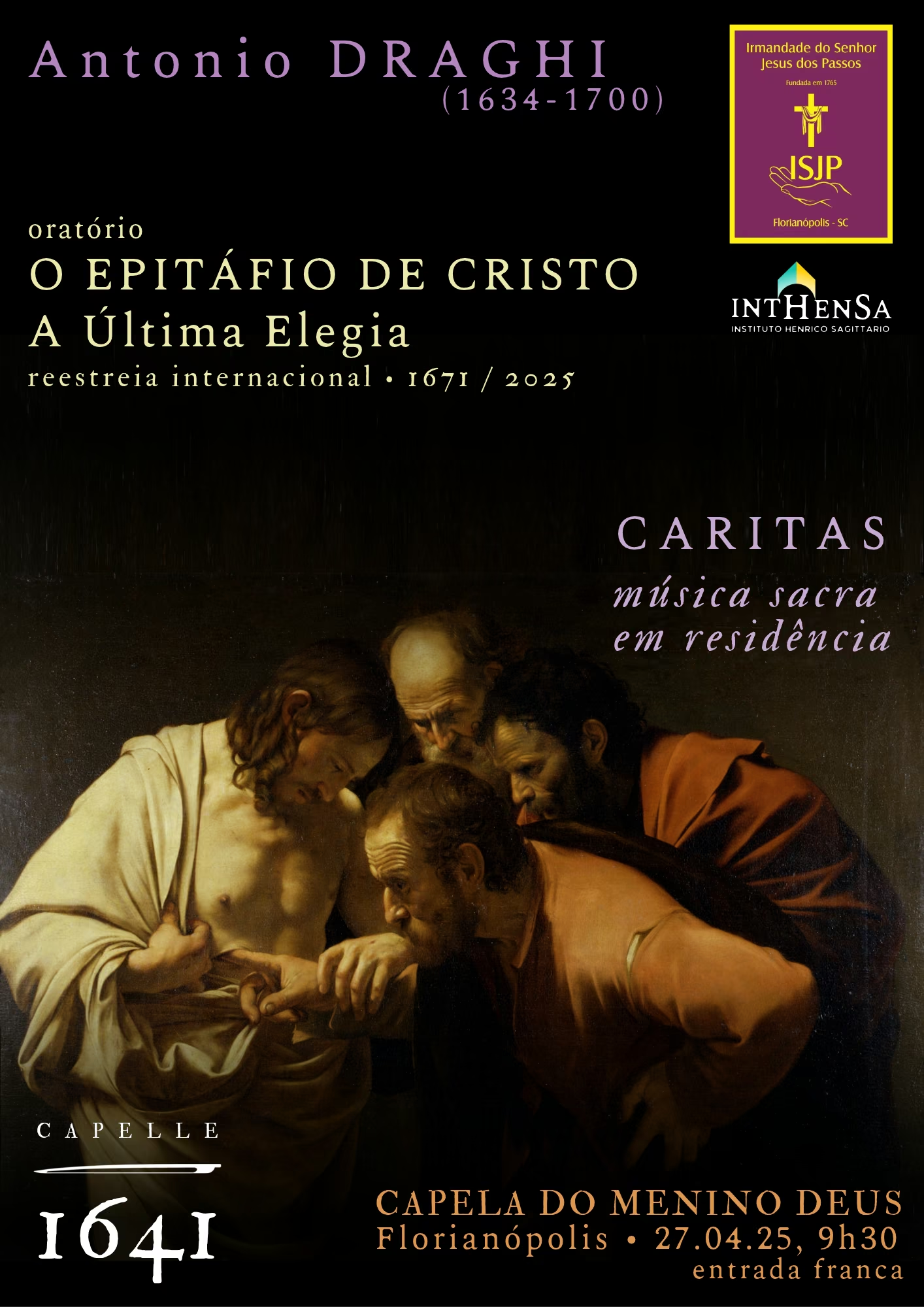
During the second half of the seventeenth century, a distinctive form of religious musical theatre known as sepolcri developed in Vienna, Austria. These were short musical dramas, drawing on the productions of Francesco Cavalli (1602-1676) and Marc’Antonio Pietro Cesti (1623-1669), inspired by the Passion of Christ and staged during Holy Week in some of the court churches. The oratorio L’Epitafio di Christo (1671), by the Italian composer Antonio Draghi (1634-1700), is one such work. After more than 350 years, this sepolcro returns to the concert stage in an international revival performed by Capelle 1641, based on a previously unpublished musicological reconstruction undertaken by its artistic director, Gustavo Gargiulo.
The musical drama, incomplete in its surviving original pages, is thus given a new completion through the inclusion of works by other composers who, like Draghi, enjoyed distinction at the Viennese court: Hieronymus Kapsberger (1580-1651); Antonio Bertali (1605-1669); Giovanni Felice Sances (c. 1600-1679); Johann Jacob Froberger (1616-1667); Heinrich Ignaz Franz von Biber (1644-1704); Paul I Esterházy (1635-1713), Palatine of Hungary; and the Holy Roman Emperor Leopold I (1640-1705) himself.
The first part of this programme, conceived by the librettist Nicolò Minato (1627-1698), takes us to the biblical scene of Jesus's tomb. There, two figures central to the Easter narrative, the Virgin Mary and Joseph of Arimathea, interact with allegorical figures: Faith, Grace, the Humanity of Christ, Sorrow, Innocence, and Divine Love. The second part, with traditional librettos adapted by the composers themselves, recalls Peter and Judas Iscariot, two figures who embody anguish, doubt, betrayal, and remorse.
Through a dialogue of contrasts, music and text confront us with the full spectrum of human passions, inviting an enduring encounter with profound questions of pain and abandonment, consolation and love, dignity and beatitude.
Performers
- GUSTAVO GARGIULO - Cornetto and trumpet
- MARÍLIA OLIVEIRA - Soprano (Virgin Mary / Innocence / Grace)
- GABRIELA GARCIA - Contralto (Faith / Christ's Humanity / Divine Love)
- NELSON GUTIÉRREZ - Tenor (Joseph of Arimathea)
- NORBERT STEIDL - Bass (Sorrow / Peter / Judas Iscariot)
- VINI CHIARONI - Violin and flauto
- ALEXANDRE NANNI - Violin and viola da braccio
- HANS TWICHELL - Viola da gamba
- CAMILA DURÃES - Violone da braccio
- LUCAS ROPELATO - Violone da gamba
- ROGER BURMESTER - Theorbo
- MARCOS HOLLER - Harpsichord and organ